ServicesWater Softeners
Water Softeners in Safety Harbor
We install ion-exchange water softeners sized to your water's hardness and your household's daily use. One person handles your job from the first question to the final cleanup, so you always know who set your system and who to ask about it later.
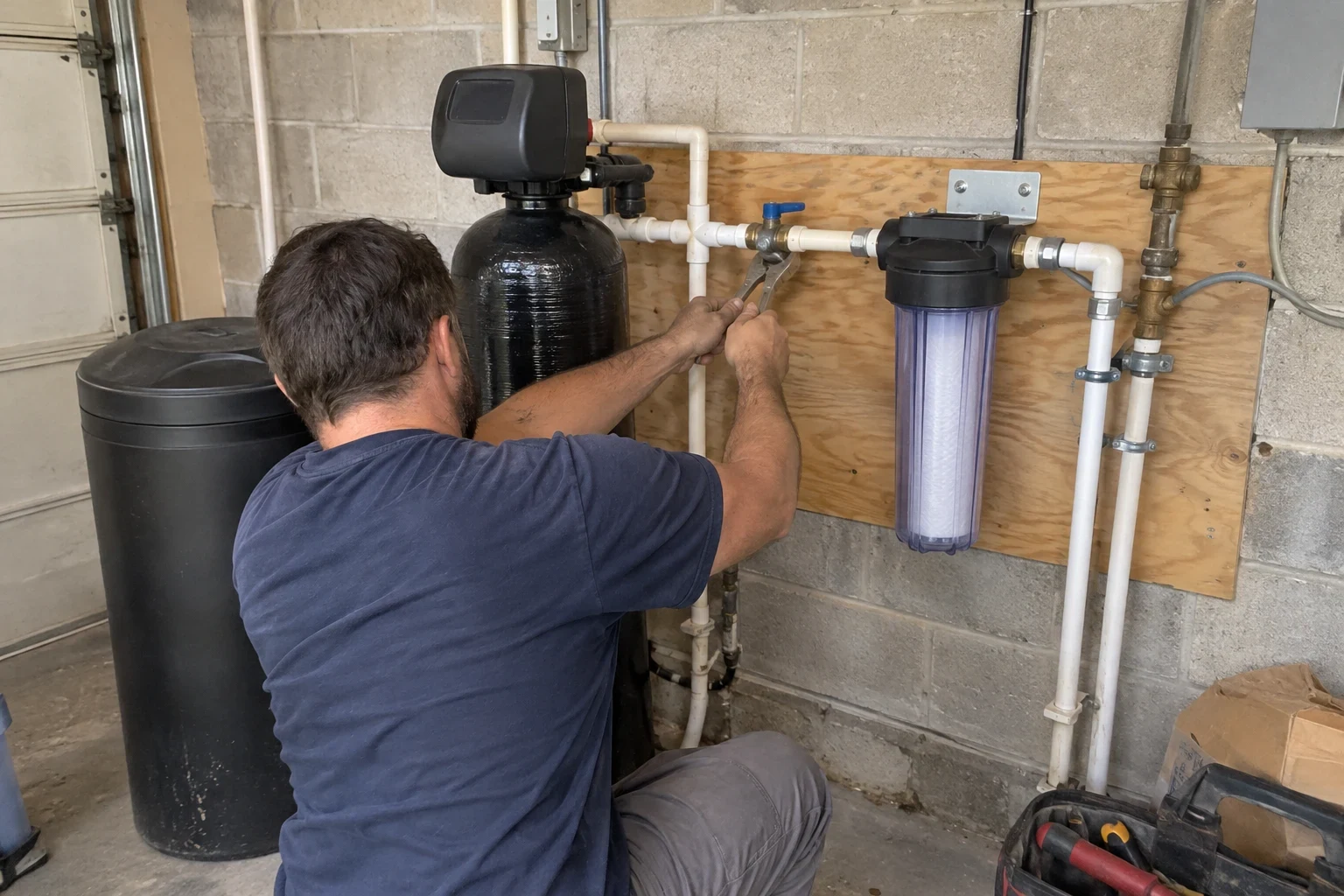
How a Softener Works and Who It Helps
Calcium and magnesium dissolved in your water are what make it hard. Heat it in a water heater or let it evaporate on a shower door, and those minerals come out of solution as scale. A softener pulls them out at the main line, before they ever reach your fixtures and appliances.
The mineral tank holds a bed of cation resin beads. Water flowing through gives up its calcium and magnesium to the beads, which release sodium or potassium in exchange. Once the beads are saturated, the control valve starts regeneration: a backwash to loosen the bed, a brine draw from the salt tank to recharge the resin, then a rinse and a refill of the brine tank.
Scale is the job a softener is built for, and it is the only one. Chlorine taste, odors and sediment pass straight through it. If those are your complaint, whole-home filtration or chlorine and chloramine removal will serve you better, and we will point you there instead of selling you a softener.
What the Installation Includes
Sizing by grain capacity
We match the unit to your hardness reading, the number of people in your home and your daily water use. Too little resin forces constant regenerations that eat salt. Too much leaves part of the bed idle, and water starts cutting channels through it.
Metered control valve
Our valves count gallons and start a regeneration only when the resin is close to exhausted. A clock-based valve regenerates on its calendar even after a week when nobody was home.
Bypass valve and main line connection
We tie the softener into your main line with a bypass valve. Turn it, and water flows around the unit, so a technician can work on the tanks without shutting off your faucets and toilets. Where the piping layout allows, outdoor hose bibs stay on unsoftened water.
Drain line with an air gap
Regeneration wastewater drops through an air gap before it reaches the drain, so it cannot be siphoned back toward the system. The brine tank overflow gets its own routed line too.
Startup and programming
We sanitize the resin, enter your hardness and capacity numbers in the valve, trigger the first regeneration and inspect each joint for drips before we pack up.
Signs Your Home Needs a Softener
White crust on fixtures
That chalky ring on faucets, showerheads and glass doors is calcium carbonate. Scrub it off and it is back within days.
Spotted dishes and glassware
A cloudy haze on glasses coming out of the dishwasher is usually mineral residue left as the water dried, not a detergent problem.
Popping sounds from the water heater
In a tank heater, mineral sediment piles up on the floor of the tank. Water trapped under that layer boils and pops, and recovery slows down. Tankless heaters may throw scale or low-flow codes instead.
Soap that will not lather
Hardness minerals react with soap and tie it up. You end up using more shampoo and detergent, and towels and clothes dry stiff.
Low flow at aerators
Small openings clog with scale first. If aerators and showerheads need regular clearing, the same deposits are building inside valve cartridges you cannot see.
How a Softener Job Runs
- 1
Phone conversation
The person you talk to first is the one who coordinates your job through to cleanup. We ask about the scale or spotting you have seen, the size of your household and whether you have a hardness figure from a utility or well report.
- 2
On-site look and written estimate
We find where the main line enters, check for an existing softener loop and measure the distance to the nearest drain and outlet. Plenty of homes around Safety Harbor bring the main in through the garage, which usually gives a tidy install spot. You have a line-item estimate in hand before anything goes on the calendar.
- 3
Installation day
We close the main valve, set the bypass and both tanks, connect the drain and overflow lines and fill the brine tank with salt. Your water will be off for part of the visit, and we tell you roughly how long at the start so you can plan around it.
- 4
Programming, cleanup and walkthrough
The valve gets programmed, a regeneration runs and every connection is checked for leaks. We carry out packaging and cut pipe, then show you how to refill salt and switch the bypass.
What Sets the Cost of Your Softener
Two things drive the number: the equipment your water and household actually require, and the plumbing work needed to tie it into your home. Every part and labor item appears on its own line in the estimate, so nothing is bundled out of sight.
- Resin volume and grain rating
- More hardness and more people means more calcium to capture between regenerations. That calls for a larger mineral tank, more resin and a brine tank that holds more salt.
- Metered or timer valve
- A demand-initiated valve carries a higher upfront price than a clock timer. Because it regenerates only after a set number of gallons, it burns through less salt and sends less rinse water down the drain year after year.
- Getting to the main line
- Homes with a pre-plumbed softener loop connect quickly. Cutting into the main in a cramped closet, or running new pipe to reach a better location, adds labor hours.
- Outlet and drain distance
- The control valve plugs into a standard outlet, and the regeneration discharge needs somewhere to go. Long runs to either one mean more line and more routing work.
- Prefilters and old equipment
- Adding a carbon prefilter to shield the resin from chlorine, or disconnecting and hauling off an existing unit, each shows up as a separate line.
Water Softener Questions
Something not covered here? (727) 217-5495
Will softened water taste salty?
Not to most people. The sodium a softener adds rises with the amount of hardness it removes, so at ordinary hardness levels it stays below what the tongue picks up. If you would rather keep sodium out of drinking and cooking water, a reverse osmosis system under the kitchen sink strips out most of it.
Can I use potassium instead of salt?
Yes. Most softeners run fine on potassium chloride. It costs more per bag and regenerates a little less efficiently, so the valve usually needs a higher brine setting. Let us know before installation day and we program the valve for it.
How often will I add salt?
Three things decide it: your water's hardness, the gallons your household uses and the size of the brine tank. A good habit is to lift the lid once a month and top up when the salt sits below the waterline. A metered valve makes each bag last longer because it regenerates only when the resin is actually spent.
Does a softener remove chlorine?
No. Over time, chlorine and chloramine break down resin beads, causing them to swell and crack. A carbon prefilter ahead of the softener shields the bed and removes the taste and smell at the same time, which our chlorine and chloramine removal page covers in detail.
Who do I call after the install?
The same person who wrote your estimate and ran your installation. Once the system is in, you keep getting help from us with maintenance, filter replacements and any service the unit needs. A question about salt, valve settings or an error code goes to someone who already knows how your system is set up.
Ready to Stop Scrubbing Scale?
Tell us what you are seeing at your fixtures and water heater. You get a straight answer on whether a softener fits, and one contact from estimate through cleanup.